

|
Product Name |
resolution |
sensor |
Mono/color |
Line frequency (kHz) |
Data interface |
|
4096×2 |
CMOS |
Color |
48fps |
CameraLink |
|
|
8192×2 |
CMOS |
Color |
48fps |
CameraLink |
|
|
2048×2 |
CMOS |
Color |
25fps |
GigE |
|
|
4096×2 |
CMOS |
Color |
12.5fps |
GigE |
-
![LA-CC-04K05B]() LA-CC-04K05BLA-CC-04K05B is an industrial camera based on advanced dual-line color CMOS technology. High-performance industrial camera lens is designed for high-resolution imaging applications. As a key
LA-CC-04K05BLA-CC-04K05B is an industrial camera based on advanced dual-line color CMOS technology. High-performance industrial camera lens is designed for high-resolution imaging applications. As a key -
![L2-GC-02K02B]() L2-GC-02K02BL2-GC-02K02B is an affordable digital line array camera that uses advanced image sensing technology and is particularly suitable for precision visual inspection, automated production lines, and
L2-GC-02K02BL2-GC-02K02B is an affordable digital line array camera that uses advanced image sensing technology and is particularly suitable for precision visual inspection, automated production lines, and -
![AX-FM-04B12H]() AX-FM-04B12HAX-FM-04B12H Built on Teledyne DALSA industry-leading CMOS line array sensors, the newly launched AxCIS series delivers highly integrated vision solutions while reducing system costs for demanding
AX-FM-04B12HAX-FM-04B12H Built on Teledyne DALSA industry-leading CMOS line array sensors, the newly launched AxCIS series delivers highly integrated vision solutions while reducing system costs for demanding -
![AX-FM-04A12H]() AX-FM-04A12HBased on Teledyne DALSA industry leading CMOS linescan sensors, the new AxCIS modules o ers highly integrated vision solutions at lower system costs for many demanding applications in machine vision.
AX-FM-04A12HBased on Teledyne DALSA industry leading CMOS linescan sensors, the new AxCIS modules o ers highly integrated vision solutions at lower system costs for many demanding applications in machine vision. -
![SG-14-02K40]() SG-14-02K40The Spyder3 SG-14-02K40 is a high-speed, highly responsive linear CCD camera from Teledyne DALSA, offering exceptional sensitivity and the ability to handle large volumes of data.
SG-14-02K40The Spyder3 SG-14-02K40 is a high-speed, highly responsive linear CCD camera from Teledyne DALSA, offering exceptional sensitivity and the ability to handle large volumes of data. -
![SG-14-01K80]() SG-14-01K80SG-14-01K80 SG-14-01K80 is a high-sensitivity, high-speed acquisition industrial camera designed for precision industrial inspection, automated production and scientific research applications. The
SG-14-01K80SG-14-01K80 SG-14-01K80 is a high-sensitivity, high-speed acquisition industrial camera designed for precision industrial inspection, automated production and scientific research applications. The -
![PX-HM-16K12X]() PX-HM-16K12XThe PX-HM-16K12X is a high-end color TDI line array camera with CMOS sensor technology, designed for high-speed, high-precision industrial inspection.
PX-HM-16K12XThe PX-HM-16K12X is a high-end color TDI line array camera with CMOS sensor technology, designed for high-speed, high-precision industrial inspection. -
![PX-HC-16K04T]() PX-HC-16K04TThe PX-HC-16K04T line scan camera uses Teledyne DALSA's advanced multi-line CMOS technology to achieve a perfect combination of high speed, high sensitivity and ultra-low noise.
PX-HC-16K04TThe PX-HC-16K04T line scan camera uses Teledyne DALSA's advanced multi-line CMOS technology to achieve a perfect combination of high speed, high sensitivity and ultra-low noise. -
![P4-CM-04K10D]() P4-CM-04K10DThe P4-CM-04K10D is a high-performance dual-line scan digital camera with a 4K resolution CMOS sensor and excellent image processing performance, designed for industrial inspection, precision
P4-CM-04K10DThe P4-CM-04K10D is a high-performance dual-line scan digital camera with a 4K resolution CMOS sensor and excellent image processing performance, designed for industrial inspection, precision -
![P4-CC-02K04T]() P4-CC-02K04TThe P4-CC-02K04T is a high-performance camera designed for industrial visual inspection, with 2K resolution, high frame rate and excellent dynamic range.
P4-CC-02K04TThe P4-CC-02K04T is a high-performance camera designed for industrial visual inspection, with 2K resolution, high frame rate and excellent dynamic range. -
![HL-HM-16K40H (BSI)]() HL-HM-16K40H (BSI)HL-HM-16K40H (BSI) is a high-precision, high-resolution, UV imaging TDI camera that uses back-illuminated (BSI) CMOS sensor technology to provide excellent photosensitivity and image quality.
HL-HM-16K40H (BSI)HL-HM-16K40H (BSI) is a high-precision, high-resolution, UV imaging TDI camera that uses back-illuminated (BSI) CMOS sensor technology to provide excellent photosensitivity and image quality. -
![HL-FM-04K30H]() HL-FM-04K30HHL-FM-04K30H is a high-speed, high-sensitivity TDI digital line scan camera with 4K resolution and a scanning speed of up to 300 kHz. It combines a global shutter CMOS sensor and high dynamic range
HL-FM-04K30HHL-FM-04K30H is a high-speed, high-sensitivity TDI digital line scan camera with 4K resolution and a scanning speed of up to 300 kHz. It combines a global shutter CMOS sensor and high dynamic range


Specification
|
Image Sensor |
1K Mode |
2K Mode |
4K Mode |
|
Bit Depth |
8-bit monochrome |
8-bit monochrome |
8-bit monochrome |
|
Line Rate (Maximum, Full Resolution) |
87 kHz (11.5 μs per line) |
169 kHz (5.9 μs per line) |
84 kHz (11.9 μs per line) |
|
Sensor Type |
1” CMOS |
1” CMOS |
1” CMOS |
|
Sensor Properties |
14 μm x 14 μm square pixels |
7 μm x 7 μm square pixels |
3.45 x 3.45 μm square pixels |
|
Maximum Image Resolution (pixels) |
1024 x 16376 (16 MP) |
2048 x 16376 (32 MP) |
4096 x 16376 (64MP) |
|
Electronic Shutter Speed |
0.1us to 1,000,000us |
0.1us to 1,000,000us |
0.1us to 1,000,000us |
Parameter
|
Memory |
4 GB |
|
Lens Type |
C-Mount only |
|
Trigger |
1 opto-isolated, acquisition trigger input |
|
Discrete Inputs |
1 opto-isolated, acquisition trigger input |
|
Discrete Outputs |
Up to 2 high-speed outputs |
|
Encoder Specifications |
10 - 30 VDC (500 kHz max) |
|
Status LEDs |
Pass/Fail LED and Indicator Ring, Network LED and Error LED |
|
Job/Program Memory |
7.2 GB non-volatile flash memory; unlimited storage via remote network device |
|
Image Processing Memory |
1 GB |
|
Network Communication |
2 Ethernet ports, 10/100/1000 BaseT with auto MDIX. IEEE 802.3 TCP/IP Protocol |
|
Communication Protocols |
TCP/IP, PROFINET, EtherNet/IP, SLMP, ModbusTCP, (S)FTP, RS-232C, IEEE 1588 (CIPSync) |
|
IEEE 1588 Support |
Timestamp resolution: 8 ns; Synchronization accuracy through transparent clock: 5 ns |
|
Power Consumption |
24 V DC ± 10%, 2.0 A maximum |
|
Material |
Die-cast aluminum and zinc housing |
|
Finish |
Painted |
|
Mounting |
Four M3 threaded mounting holes. See Accessories for supported mounts. |
|
Weight |
In-Sight 3800 with no accessories attached: 570 g (20.10 oz) |
|
Ambient/Environment Temperature |
0° C to 40° C (32° F to 104° F) |
|
Storage Temperature |
-20° C to 80° C (-4° F to 176° F) |
|
Humidity |
<95% non-condensing |
|
Protection |
IP67 with all cables properly attached (or the provided connector plug installed) and the IP67-rated cover |
|
Shock (Packaging) |
IEC 60068-2-27: 18 shocks (3 shocks in each polarity in each (X, Y, Z) axis) 80 Gs (800 m/s2 at 11 ms, half-sinusoidal) with cables or cable plugs and a 150 gram or lighter lens attached. |
|
Vibration (Shipping and Storage) |
IEC 60068-2-6: vibration test in each of the three main axis for 2 hours at 10 Gs (10 to 500 Hz at 100 m/s2 / 15 mm) with cables or cable plugs and a 150 gram or lighter lens attached. |
|
Regulations/Conformity |
CE, FCC, KCC, TÜV SÜD NRTL, EU RoHS, China RoHS |
Advantages of Line Scan Camera
High resolution
The line scan camera is capable of sub-micron resolution, applicable to the inspection needs of products of different widths.
High-speed acquisition
Supports scanning speeds of tens of thousands of lines per second, suitable for inspection scenarios that require fast response.
Distortion splicing
Since the sensor has only one line of pixels, there is no need to account for perspective distortion, making image splicing more accurate.
High stability
Highly adaptable to lighting conditions and environmental disturbances, able to achieve stable detection in complex environments.
Types of Line Scan Camera
Single line cameras
The single line scan camera is the simplest and most commonly used line scan camera, typically with a resolution of up to tens of thousands of lines. Its main feature is faster, suitable for high-speed imaging of moving objects; but because only one line at a time can be imaged, so for the width of a larger or non-conventional shape of the object imaging is more difficult.
Multi-line scan camera
Multi-line scanning camera in the single-line scanning camera based on more linear image sensors, can simultaneously image multi-line image. Its main feature is suitable for wider, more complex shape of the object imaging, and can improve the imaging efficiency and accuracy.
TDI line scan camera
TDI (Time Delayed Integration) line scan camera is a special line scan camera, its image sensor integrated multiple CCD arrays, and can read out the image before the image of different arrays of image signals for the time-delayed integration, which greatly improves the imaging quality and sensitivity. TDI line scan camera is widely used in high-speed trains, bearings and other fields.
Surface scan camera
Face scanning camera is another common imaging device, its image sensor for the two-dimensional array structure, can be a one-time access to the whole image, so it is suitable for static or slow-motion object imaging. Compared with the line scan camera, the surface array scanning camera application range is narrower, but in the imaging stability, imaging speed performance is excellent.
Contact image sensor (CIS)
CIS is a new type of photoelectric imaging sensors, through the close arrangement of light sensitive units directly capture the reflected light of the scanned object, without the need for a lens group.CIS cameras have the advantages of compact structure, low cost, suitable for macro detection and scanning tasks.

High resolution: Line scan cameras can achieve extremely high resolutions because the length of the image is not limited by the sensor size. The resolution along the scanning axis depends on the precision and speed of the movement.
Uniform illumination: Ensures uniform illumination across the entire field of view, reducing lighting inconsistencies.
High speed: Suitable for high-speed applications as they can capture images quickly without the need for large sensor arrays.
Applications Of Line Scan Camera
Industrial inspection
• Use case: Inspecting products on a production line for defects or quality control.
• Advantage: High resolution and speed allow for precise inspection of fast-moving items.
Print inspection
• Use case: Checking the quality of printed materials such as newspapers, magazines, and labels.
• Advantage: Ability to capture fine details and detect defects over large print surfaces.
Web inspection
• Use case: Monitoring continuous materials such as paper, textiles, or metal sheets during production.
• Advantage: Continuous scanning capability ensures complete coverage and detection of defects.
Surface inspection
• Use case: Inspecting surfaces of large objects like aircraft wings, vehicle bodies, or ship hulls.
• Advantage: Ability to scan large, continuous surfaces with high precision.
Document scanning
• Use case: Digitizing large-format documents, books, or artworks.
• Advantage: High-resolution scanning ensures accurate reproduction of the original material.
Our Certificate

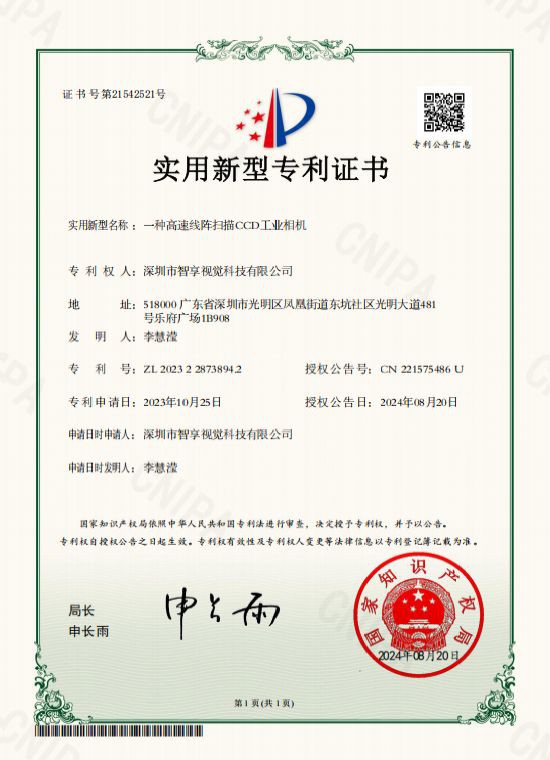

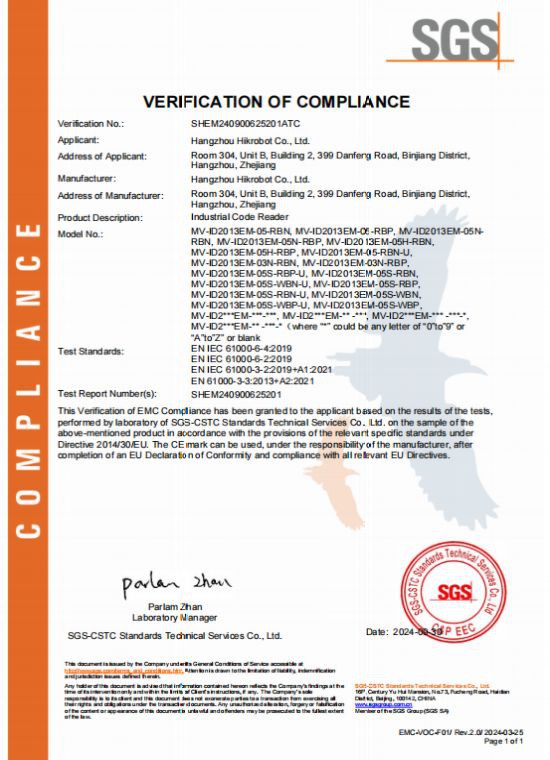

As one of the leading line scan camera suppliers in China, we warmly welcome you to wholesale discount line scan camera in stock here and get quotation from our factory. All our products are with high quality and competitive price.
MV-CS200-10UC, mercury second generation super me2s u3 series


