

Traditional industrial cameras are difficult to meet the complex detection needs on site. With the rapid development of intelligent manufacturing, the new machine vision is changing the production line production situation. Smart cameras are becoming the new favorite of manufacturing sites with their highly integrated design, excellent image processing capabilities and good scalability. It not only reduces the difficulty of system integration, but also significantly improves the detection efficiency and accuracy. The following will explain in detail the five major application advantages of smart cameras in manufacturing sites.
1. Edge computing drives to improve detection efficiency
In high-speed production lines, 3C electronics, lithium battery packaging, automotive parts assembly and other scenarios, the traditional solution is a complex system composed of industrial computers + industrial cameras + software processing, which is not only cumbersome to wire, but also has response delays.
Smart cameras integrate image acquisition, processing and communication, and quickly judge good or bad products through local algorithms, greatly reducing system delays and detection efficiency, and truly realizing immediate judgment after shooting.
2. High-precision positioning meets the needs of automated assembly
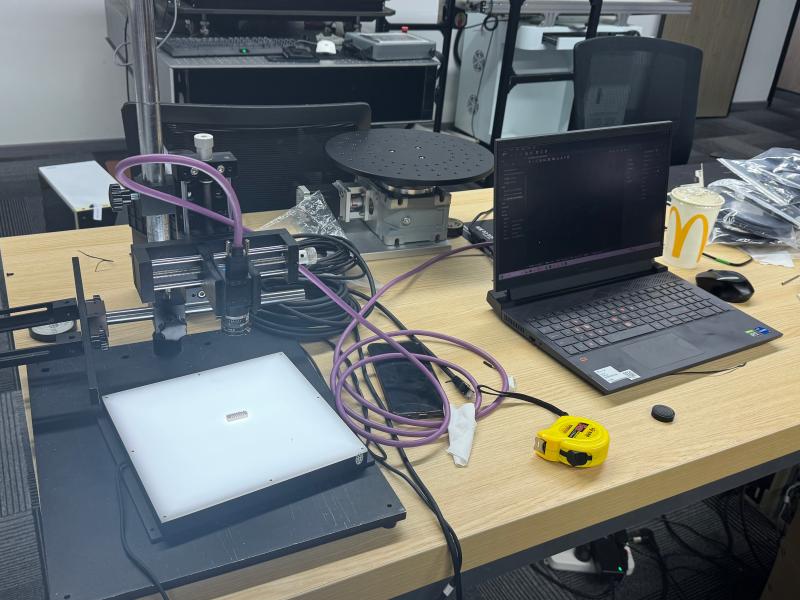
In the field of precision assembly: chip bonding, electronic component insertion, mobile phone camera module assembly, etc., higher requirements are placed on the positioning accuracy and stability of visual inspection systems. Compared with manual and low-resolution systems, smart cameras achieve high-precision guidance positioning and calibration through built-in high-pixel algorithms and high-resolution imaging, effectively supporting robot operations. With deep learning and template matching algorithms, smart cameras can adapt to deformation and offset under a variety of complex backgrounds, effectively improving the accuracy of production line detection.
3. Multi-task flexible detection system
In traditional machine vision systems, multi-variety and small batch modes have become the norm for production lines. In the past, parameters had to be adjusted for such frequent product switching. Smart cameras can solve multi-task switching and intelligent recognition functions with one device. Smart cameras integrate image acquisition, processing and communication functions. By simply changing parameter configuration and algorithm deployment, the switching of detection logic can be quickly completed, greatly improving the flexibility and response speed of the production line.
4. Smart camera + AI
Ordinary visual inspection has high requirements for product consistency and is not easy to adapt to changes in the working environment during production. For example: in surface defect detection, the same type of scratches have too different shooting effects due to differences in lighting or materials. This situation needs to be processed in combination with AI algorithms. Smart cameras can learn and have the ability to understand in applications, and can make minor changes, impurities, scratches and other bad performances more robust. Smart cameras are currently widely used in metal surface detection, food sorting, plastic defect recognition and other fields.
5. One-stop platform management simplifies deployment
With the increase in the number of devices, traditional visual systems are prone to complex maintenance and inconsistent supporting equipment. Therefore, Zhixiang launched a one-stop platform configuration, which can realize one-stop services such as remote configuration, equipment management, and algorithm updates, greatly reducing the factory operation and maintenance costs. At the same time, multiple smart cameras can work together, and through the remote control platform, it is convenient to centrally control multiple sites, improve maintenance efficiency and operation stability.
The rapid popularization of smart cameras has promoted the evolution of industrial vision in the direction of "faster, smaller, and stronger", and has become a key component of the production line. It also helps more companies move from passive detection to active optimization, making production easier and easier. If you also encounter difficulties in product detection, please consult us, and we will provide you with professional visual solutions.


