

Driven by the wave of digital transformation, the manufacturing industry has a growing demand for "flexible production". Traditional rigid production lines have been unable to cope with market changes in multiple varieties, small batches, and fast delivery. As an important technical support for flexible manufacturing, intelligent vision systems are accelerating their deep integration with robots and automation equipment to promote the upgrade of production lines to "smart + flexible".
1. What is production line flexibility? Why is it important?
Flexible production lines refer to automated systems that can adapt to rapid product switching, adjust process flows, and respond to diversified production needs. Compared with traditional models, it has higher adaptability, rapid response capabilities, and cost control advantages. The visual system empowers equipment by providing the functions of "eyes + brain", enabling smarter perception and decision-making, and has become a key link in flexible production.
2. Key capabilities of flexible intelligent vision systems
Adaptive recognition and positioning
Based on deep learning algorithms, smart cameras can automatically identify products of different shapes, sizes, and colors, achieve dynamic alignment and precise positioning, reduce dependence on fixtures, and improve equipment compatibility.
Fast switching of multiple varieties
Through modular configuration and preset task library, the visual system can quickly switch between different processes or categories without frequent hardware adjustment, meeting the needs of small batch and multi-variety production.
Automatic detection and feedback of abnormalities
The system integrates defect detection, dimension measurement, identification and judgment and other functions, performs real-time quality control in different production rhythms, and feedbacks adjustment strategies to ensure stable operation of the production line.
Collaborative operation with robots
Visually guide collaborative robots to perform loading and unloading, assembly, inspection and other operations, so that the entire production line has the "identification-judgment-execution" closed-loop capability, realizing truly unmanned flexible operation.
3. Actual combat case: flexible inspection production line in 3C electronics industry
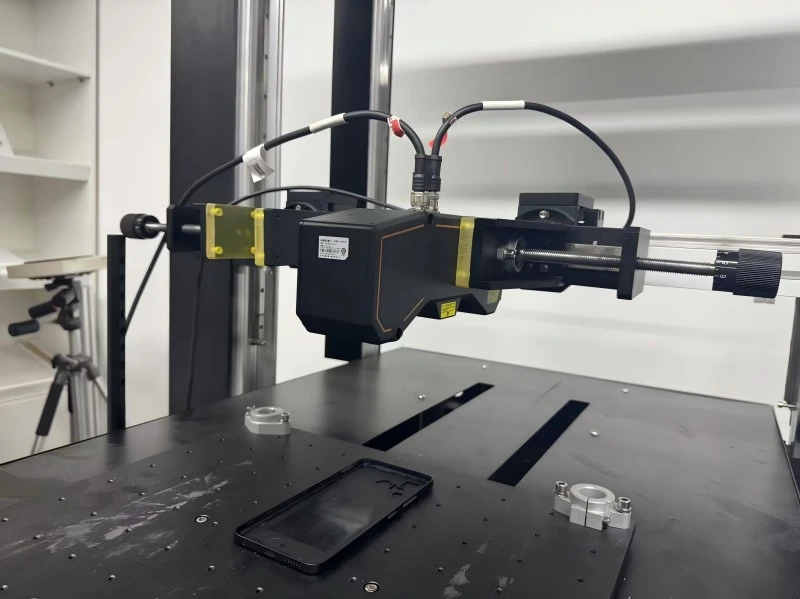
A 3C electronics customer faces the challenge of parallel production of multiple models of products. Traditional production lines require frequent replacement of fixtures, low efficiency of manual inspection and high error rate. Zhixiang Vision customized and deployed a set of intelligent vision + collaborative robot system for it:
Industrial cameras are used in the front section to identify product barcodes, LOGOs, etc., and the system automatically identifies product models;
In the middle section, AI visual algorithms are used to detect surface defects and assembly status of different products;
In the back section, robots complete sorting, classification and packaging operations, and the visual system provides positioning guidance.
Through this system, customers have realized the automation of mixed-line detection of multiple products, increased production efficiency by 40%, reduced labor by 60%, and successfully supported the switching of more than ten models, significantly enhancing the flexibility of production lines.
AI algorithm + integrated equipment becomes mainstream
As AI algorithm capabilities are enhanced, visual systems will tend to be more integrated and edge intelligent. Smart cameras equipped with deep learning chips and integrated visual platforms are becoming the new main force of flexible production lines. Combined with high-speed communication technologies such as 5G and industrial Ethernet, the system response speed will be further improved, enabling manufacturing to move from refinement to adaptation.
Flexible manufacturing is not a distant concept, but a realistic need for current manufacturing upgrades. Through the introduction and optimization of intelligent visual systems, companies can respond to market changes more efficiently and achieve high-quality, high-efficiency and low-cost production goals. In the future, intelligent vision will not only be able to "see clearly", but also be a productivity engine that can "understand and do accurately".


