

Recently, the Intelligent Vision Technology team successfully completed the testing of a component sample sent by an automotive manufacturing customer. This sample is a commonly used adjustment switch button assembly in automobiles, involved in vehicle function adjustment and driving interaction, and is a crucial detail component in automotive electronics. To ensure product consistency during vehicle assembly and long-term use, the customer had strict requirements regarding the integrity of the button structure and the consistency of its appearance color, seeking a vision-automated solution to replace manual inspection.
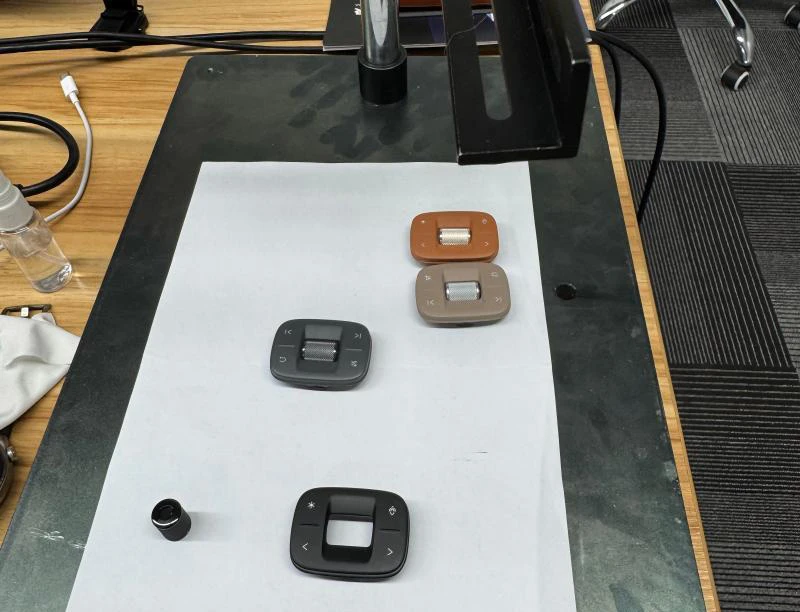
Define the needs
Based on the testing standards provided by the client, this test includes two main tasks:
1. Button Outline Structure Recognition
This involves using visual algorithms to determine the integrity of the button's shape, including:
whether the outline is deformed
whether there are burrs or bumps on the edges
whether the scroll wheel position is offset
These structural issues are often small and subtle, requiring high uniformity of lighting and high camera resolution.
2. Scroll Wheel Color Recognition
Due to the special material of the scroll wheel, its surface has slight reflectivity. The client needs the system to accurately distinguish color differences between different batches to avoid mixing issues during final assembly.
This places high demands on color reproduction accuracy, light source color temperature consistency, and the camera's color algorithm.
Technical solution
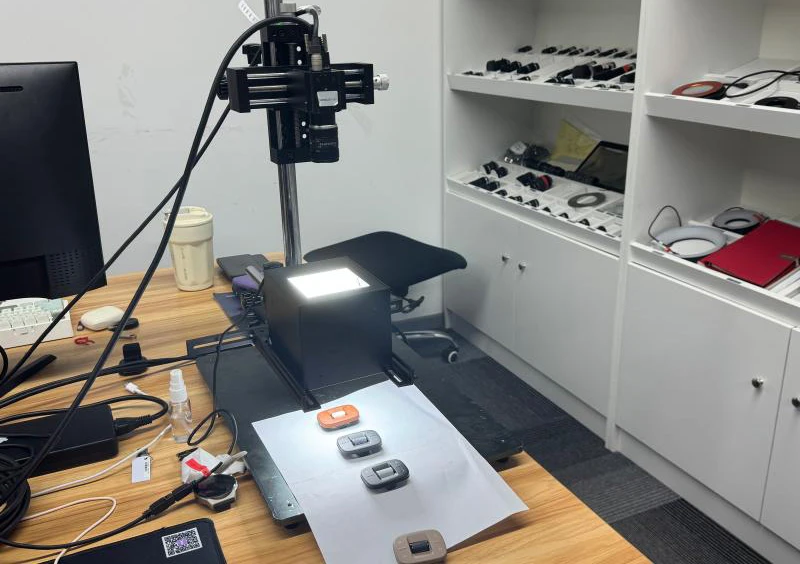
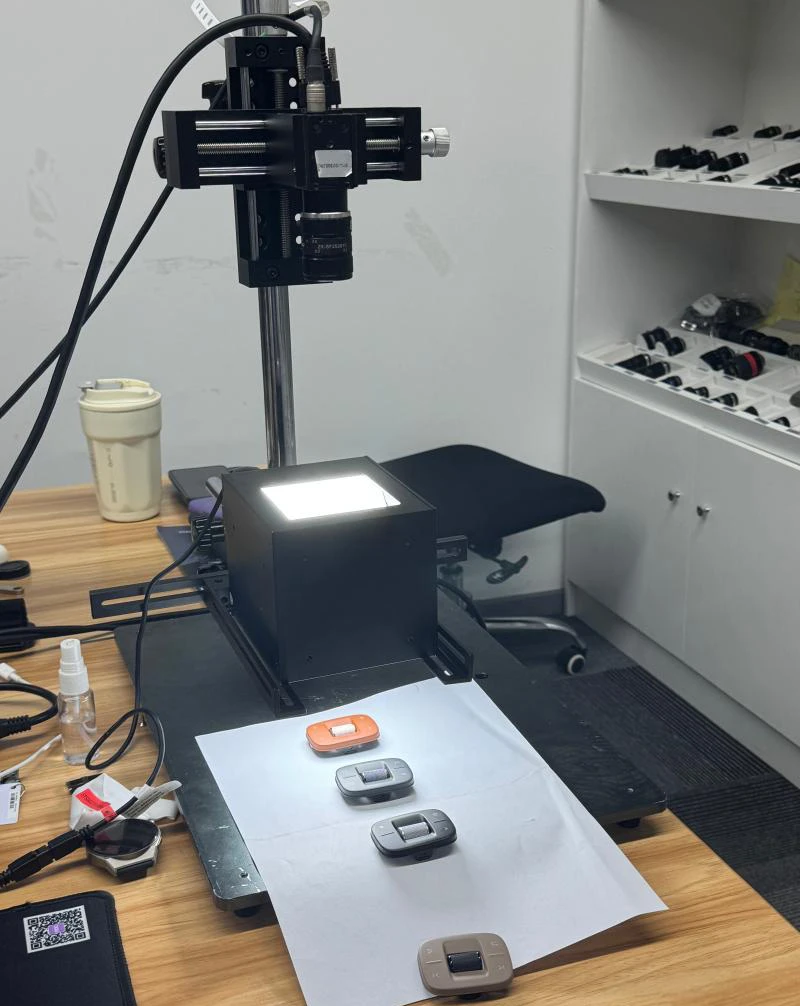
After a comprehensive analysis of the product structure and testing environment, our technical team developed a professional testing solution for the client: an integrated configuration of industrial camera + precision lens + light source system + adapter, which was then validated:
High-resolution industrial camera:
To ensure the accuracy of contour extraction, we selected a high-pixel area array industrial camera to accurately capture detailed areas and ensure consistent image clarity across different batches of samples during appearance inspection.
High-performance industrial lens:
A high-quality lens effectively reduces distortion and color cast, resulting in sharper contour edges and more realistic roller colors, providing a clean image foundation for subsequent algorithm recognition.
Customized light source system:
Based on the button reflectivity, our engineers configured a combination of soft light and coaxial light sources:
Soft light suppresses surface reflection and improves color stability
Coaxial light highlights edge features and improves the accuracy of structure detection
The light source is a key factor in the success of color recognition and appearance inspection. The lighting scheme underwent multiple rounds of adjustments to achieve optimal results in this test.
Power supply and data adapter:
Stable power supply and data transmission ensure the real-time performance of image acquisition and the reliability of system operation.
Test performance
After multiple rounds of repeated testing, the system demonstrated excellent performance in the following aspects:
Sharp contour edges, with subtle defects clearly discernible.
Stable roller color recognition with no significant color difference interference.
Excellent image noise control, maintaining good image quality under different exposure conditions.
High algorithm recognition accuracy, with no significant false positives or false negatives during continuous inspection.
Overall test results show that this solution can fully support customers in achieving fully automated visual inspection on production lines, significantly improving inspection efficiency and reducing labor costs.
As a comprehensive solution provider specializing in machine vision hardware and visual algorithm applications, Zhixiang Shijue has provided solutions for appearance inspection, dimensional measurement, and assembly verification to numerous automotive manufacturers, earning the trust of its clients.
In the future, we will continue to explore more possibilities for visual inspection in industries such as automotive electronics, 3C electronics, and precision manufacturing, contributing more to the intelligent development of industry through high-quality hardware and professional technical services.


