

In machine vision and industrial imaging, Dynamic Range is one of the core performance indicators affecting image quality. It describes the ability of an image to simultaneously display details in both bright and dark areas.
When a camera's dynamic range is insufficient, images often suffer from overexposure in bright areas and complete darkness in dark areas, leading to loss of detail and severely impacting detection accuracy and algorithm recognition precision. Therefore, the introduction of HDR (High Dynamic Range) technology has brought more realistic, clearer, and more detailed imaging effects to industrial vision systems.
What is HDR technology?
HDR technology optimizes different brightness areas during the imaging process, enabling images to retain rich tonal gradations and details even in complex scenes with both highlights and shadows.
It is widely used in industrial inspection, autonomous driving, traffic monitoring, medical imaging, and other fields, especially in high-contrast environments with drastic lighting changes or reflective metals, where the advantages of HDR imaging are particularly prominent.
Currently, common HDR implementation methods in industrial cameras mainly include: single-frame HDR, dual-gain HDR, and multi-frame HDR.
Single-frame HDR
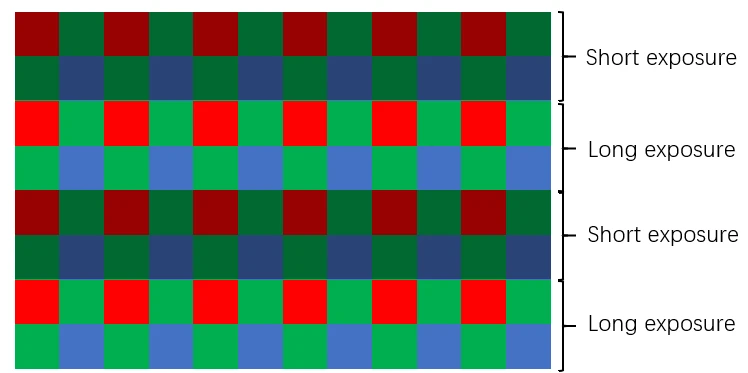
Single-frame HDR refers to a technology that simultaneously captures information from both bright and dark areas in a single exposure. The system records light signals from different brightness areas within the same frame and fuses them using algorithms to generate a high dynamic range image.
Advantages:
Requires only one exposure, eliminating the need for multi-frame fusion;
Effectively avoids issues such as content misalignment and motion blur that occur in multi-frame HDR solutions;
Fast imaging speed, suitable for dynamic scenes.
Disadvantages:
Most single-frame HDR technologies sacrifice some spatial resolution;
Requires more sophisticated image processing algorithms.
This technology is well-suited for high-real-time industrial applications such as high-speed detection and moving target imaging.
Dual Gain HDR
In CMOS image sensors, signal brightness can be enhanced through gain adjustment (such as analog gain and digital gain).
Dual Gain HDR technology is based on this principle, achieving a wider dynamic range by using different gain channels under different exposure conditions.
Currently, two common dual gain methods include:
DCG (Dual Conversion Gain): achieving dual conversion gain at the pixel level;
DGA (Dual Gain Amplifier): achieving dual amplification gain in the readout circuitry.
This approach can enhance detail in bright areas while reducing noise in dark areas, allowing the camera to maintain high contrast and low noise output even in complex lighting conditions.
Therefore, dual gain HDR technology is widely used in high dynamic range scenarios such as semiconductor inspection, metallic reflective surface inspection, and outdoor traffic monitoring.
Multi-frame HDR
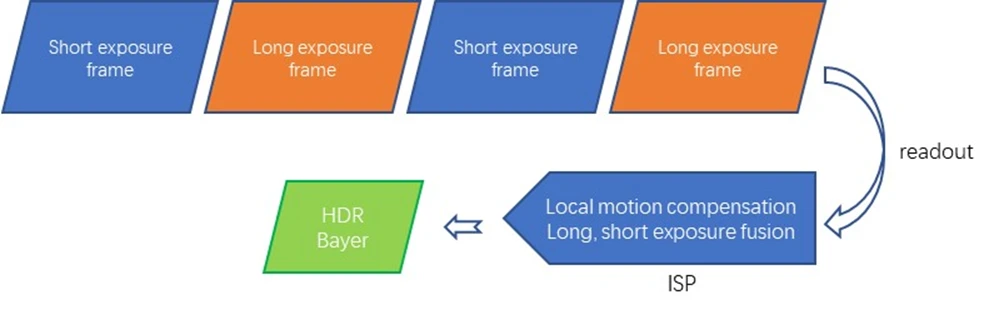
Multi-frame HDR (Multi-frame HDR) achieves a wider dynamic range by capturing multiple frames with different exposure times and fusing them in a backend algorithm.
Compared to single-frame HDR, multi-frame HDR does not lose spatial resolution but suffers from a decrease in temporal resolution.
Common multi-frame implementations include:
Frame-based HDR
This involves capturing a long-exposure frame followed by a short-exposure frame, then fusing them using an ISP (Image Signal Processing) to generate an HDR image.
Disadvantages: Due to the time difference between the two frames, motion blur or frame rate drops are likely to occur.
Advantages:
Preserves rich details and produces natural transitions between light and dark areas;
High image quality, suitable for static detection scenarios.
Disadvantages:
Not effective for moving targets;
Higher processing latency limits real-time performance.
The application of HDR technology enables Industrial Cameras to overcome the physical limitations of traditional imaging, bringing more realistic and accurate image information to machine vision. From electronics manufacturing to autonomous driving, from surface defect detection to automated sorting systems, HDR is becoming a key technology for improving the reliability and intelligence of visual inspection.
In the future, with the continuous improvement of image sensor performance and algorithm optimization, HDR will not only be a functional parameter of industrial cameras, but also a core competitive advantage of intelligent imaging systems.


