

In machine vision inspection systems, the selection of industrial lenses directly determines image quality and inspection accuracy. Especially in applications such as PCB solder joint inspection and precision dimensional measurement, problems such as parallax error, difficulty in distortion control, and severe reflection interference are frequently encountered. Traditional industrial lenses often struggle to balance accuracy and stability in these scenarios, while telecentric lenses were developed specifically to address these issues.
In a recent PCB solder joint inspection test completed by Zhixiang Shijue, telecentric lenses, with their unique optical structure, demonstrated significant advantages in solder joint location detection and contour imaging, providing a reliable guarantee for high-precision visual inspection.
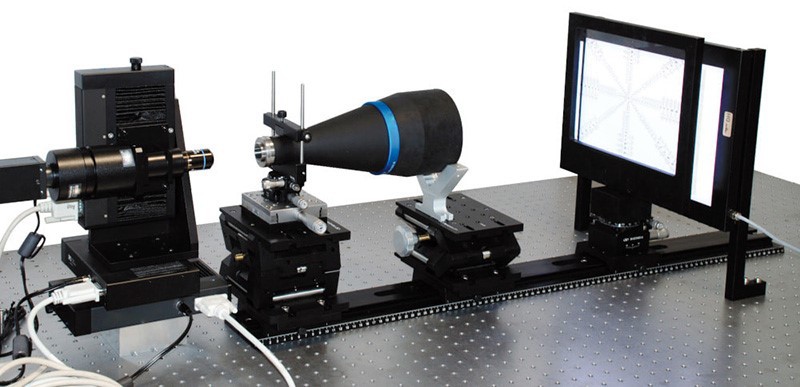
Limitations of Ordinary Lenses
In practical visual inspection, ordinary industrial lenses commonly exhibit a perspective effect, where objects appear larger when closer and smaller when farther away. Even slight differences in the height of the object being measured can alter the image size, directly impacting measurement accuracy. Furthermore, in the inspection of metal solder and reflective surfaces, issues such as highlights and blurred edges can easily occur.
Telecentric lenses, by receiving only parallel light, effectively eliminate perspective errors, ensuring a consistent image size of the object at different heights and fundamentally resolving the accuracy concerns caused by parallax. Simultaneously, they offer stronger suppression of stray light, resulting in images with sharp edges and stable contrast.
Working Principle of Telecentric Lenses Explained
The core of a telecentric lens lies in its unique optical structure design.
By introducing multiple sets of high-precision lenses into the optical system and carefully controlling the spacing between them, the imaging light rays are kept parallel before entering the camera, thus achieving telecentric imaging.
In a dual telecentric lens structure, the system possesses both object-side and image-side telecentric characteristics, ensuring both dimensional consistency and image sharpness and stability.
This design not only significantly reduces distortion but also makes image edges sharper, providing a higher-quality image foundation for subsequent visual algorithms.
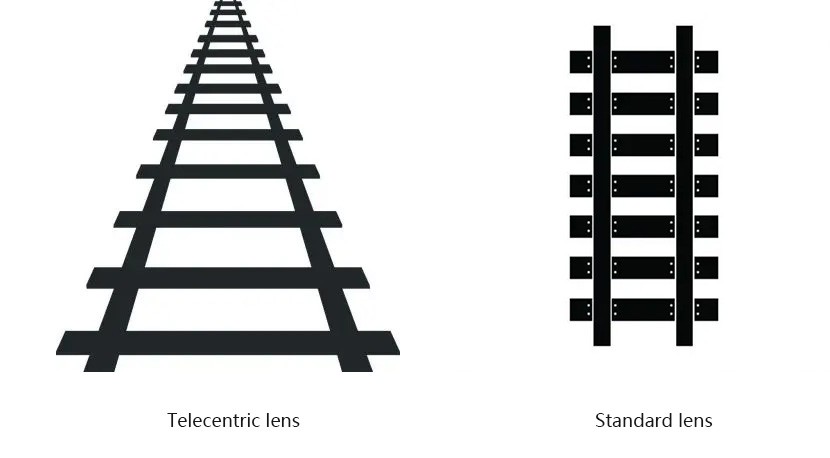
The core advantages of telecentric lenses:
Compared to ordinary industrial lenses, telecentric lenses are more complex in structure and performance, but their advantages are equally prominent:
Nearly no perspective error, suitable for high-precision dimensional measurement
Extremely low distortion, clear contour boundaries, and more stable measurement results
Greater depth of field, capable of clear imaging at different heights simultaneously
Strong adaptability to reflective surfaces, improving the success rate of metal and solder inspection
Therefore, although telecentric lenses are relatively more expensive, they possess irreplaceable value in the field of precision inspection.

Applications of Telecentric Lenses in Various Industries
Semiconductor and Chip Inspection
In semiconductor manufacturing, chips are extremely small and require extremely high precision. Telecentric lenses, with their stable imaging ratio and high contrast characteristics, are widely used in chip appearance inspection, dimensional measurement, and defect identification, effectively improving inspection consistency and yield.
PCB Soldering and Electronic Manufacturing Inspection
In PCB soldering inspection, solder joints are small, densely distributed, and highly reflective. Telecentric lenses can clearly present the outline and positional boundaries of solder joints, providing reliable image support for the automatic identification of problems such as solder misalignment, insufficient solder, and excessive solder. It is a commonly used imaging solution in high-end electronic manufacturing.
Transparent Object and Glassware Inspection
For inspection scenarios such as transparent glass bottles and transparent plastic parts, telecentric lenses can effectively reduce ambient light interference, clearly identify minute defects such as scratches, bubbles, and white spots, significantly improving inspection accuracy.
Precision Measurement of Automotive Parts
In automotive parts production, telecentric lenses are widely used in aperture measurement, contour inspection, and assembly inspection. They can maintain stable imaging at different working distances, helping to achieve high-consistency quality control.
Professional Imaging Solution Inspection
As a technology service provider specializing in machine vision applications, Zhixiang Shijue continuously deepens its expertise in the systematic application of telecentric lenses, industrial cameras, and light sources in the PCB, semiconductor, and electronics manufacturing sectors. Through rational solution design and on-site testing and verification, we help customers achieve more stable and efficient visual inspection in complex inspection scenarios.
In the future, Zhixiang Shijue will continue to optimize its telecentric imaging solutions to meet the demands of high-precision inspection, providing a more reliable visual foundation for intelligent manufacturing.


