

In the context of the rapid development of intelligent manufacturing, machine vision systems are gradually becoming the core technology of key links such as quality control, defect identification, and dimensional measurement. In the entire visual system, industrial lenses are an important part of front-end imaging. Their selection will directly affect the clarity of the image, the detection accuracy of the system, and the stability of equipment operation.
The following will use actual industry cases to deeply analyze the selection logic of industrial lenses and the key points of selection in various industry applications, providing a reference for enterprises to build efficient and stable visual systems.
I. 3C electronics industry: high resolution + low distortion to ensure the recognition of tiny structures
3C electronics industry: high resolution + low distortion to ensure the recognition of tiny structures
In 3C electronic scenes such as mobile phone structural parts, FPC solder joints, and circuit board detection, tiny precision detection needs are often involved. These scenes have higher requirements for lens resolution, distortion control, and depth of field measurement.
Practical application cases:
The electronic factory detects the screw holes in the middle frame of the mobile phone, and needs to identify the gaps and burrs with a diameter less than 0.8mm. The ZX-SF1628Z fixed-focus lens that supports 2/3-inch photosensitive surface is selected. When paired with a 5-megapixel camera, it achieves a clear edge and precise positioning detection effect.
Selection points:
Optical resolution ≥ camera pixel size requirements
Control distortion <0.1% to ensure measurement accuracy
High-throughput aperture design to improve imaging quality under low light conditions
II. Food packaging industry: wide field of view + large depth of field to cope with high-speed production line detection
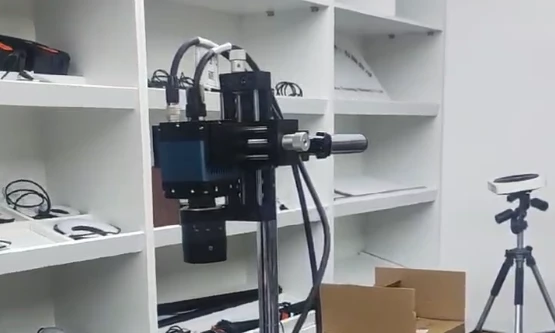
In the food industry, the visual system is mainly used to identify packaging defects: printing offset, sealing abnormality, barcode information error, etc. Due to the space and stability requirements of the high-speed production line, the lens needs to have a large field of view, a large depth of field, and anti-pollution capabilities.
Practical application cases:
Dairy companies deploy visual application systems on automatic packaging lines, use 16mm fixed-focus lenses to read multiple rows of labels at one time, and combine with Gige cameras to achieve stable detection on high-speed production lines. To cope with the condensation water environment, the lens has added an anti-fog protective glass structure, and the lens can still maintain clear imaging in the application.
Selection points:
Sufficient field of view, can cover multiple targets
Depth of field requirements, adapt to the height of the bottle
The lens is resistant to pollution, temperature difference, and adapt to humid environments
III. Lithium battery industry: telecentric lens + low reflection, to cope with high-precision size detection
In scenarios such as battery poles, copper foil slitting, and solder joint inspection, extremely high requirements are placed on detection accuracy and geometric stability, especially in measurement scenarios, where detection needs to avoid magnification changes and distortion errors.
Actual application cases:
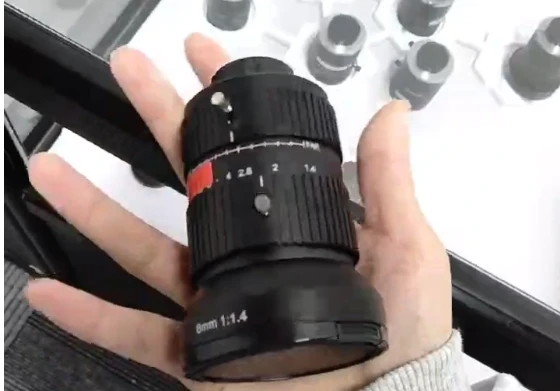
The lithium battery equipment factory detects the width and alignment of the pole ears, using a telecentric lens with a linear array camera to ensure consistent magnification throughout the field of view, effectively controlling the size deviation within ±0.02mm.
Selection points:
Use telecentric lenses to suppress image distortion
The lens needs to have high anti-reflection ability to avoid interference from copper foil mirrors
Support factory working distance design to improve equipment safety and maintainability
IV. Core parameters for lens selection
When selecting industrial lenses, it is crucial to understand and grasp several key parameters:
Focal length: determines the size of the camera's field of view and the magnification of the image. Users need to reasonably select the focal length according to the size of the object being measured, the installation distance, and the field of view coverage to ensure that the target is fully and clearly imaged.
Resolution: The lens should match the pixel size of the industrial camera, or even slightly higher than the pixel resolution requirement of the camera, to ensure sharp edges and clear details of the image, and avoid blurring that affects detection accuracy.
Distortion: Distortion control is also an important indicator for detection applications. When measuring and aligning dimensions, it is recommended to use a lens with a distortion rate of ≤0.1%. If you need to keep the full field of view magnification consistent, you should give priority to using a telecentric lens to eliminate geometric errors.
V. Conclusion: Choose the right lens to lay a solid foundation for the visual system
The reasonable selection of industrial lenses not only determines the image quality, but also is the cornerstone to ensure the long-term stable operation of the entire visual inspection system. With the continuous pursuit of automation and intelligence in industrial manufacturing, it will become the core direction of lens selection in the future.
Zhixiang Shijue provides a variety of lenses, covering a variety of product lines such as standard fixed focus, telecentric lenses, and low distortion lenses, and widely serves 3C electronics, lithium batteries, automotive parts, packaging, food and medicine and other industries. If you need a customized recommendation or need a lens test sample, please Contact US and we will provide you with a professional technical team and application selection guidance.


