

In machine vision and automated inspection, Industrial lenses, also known as optical lenses, serve as the core components of imaging systems and directly determine image clarity and accuracy. Industrial lenses are crucial elements in industrial inspection systems, and their imaging quality directly impacts their overall performance. The development of intelligent manufacturing continues to pose new challenges to imaging technology. To meet the demands of imaging applications, a diverse range of industrial lenses has been developed. So, with so many lenses to choose from, how do you choose the right one?
Industrial lens selection steps
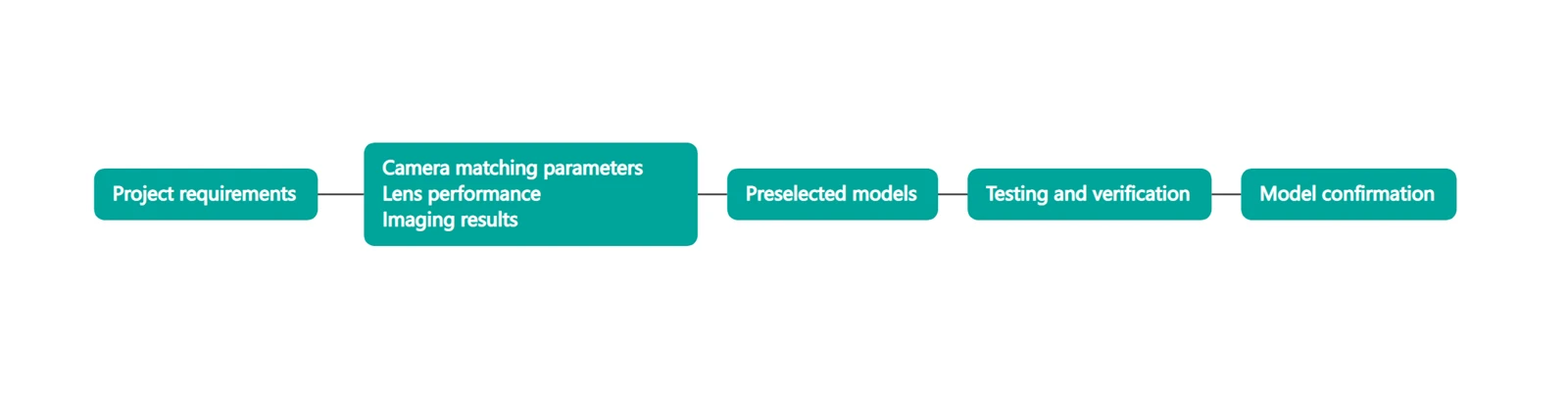
When selecting an industrial lens, clarifying the project's inspection requirements and confirming lens parameters and imaging performance are key. Customer needs vary, and the selection process must be adjusted to meet these needs. The following steps are generally necessary:
Determine the inspection requirements: Based on the application scenario, determine whether a lens is required for an area scan camera or a line scan camera, the size of the inspection target, the required accuracy, and the operating environment.
Match the camera parameters: The lens must be consistent with the camera's resolution, sensor size, and pixel size to ensure image quality.
Consider optical performance: Based on the target size and installation space, optimally select parameters such as focal length, working distance, magnification, and depth of field.
Focus on distortion and image uniformity: For precision inspection, minimize distortion and ensure image consistency between the edges of the field of view and the center.
Consider the installation environment: Select an appropriate optical mount (such as C-mount, CS-mount, or F-mount), taking into account the lens overall optical length and mounting space.
Detailed explanation of common parameters of industrial lenses
Focal Length
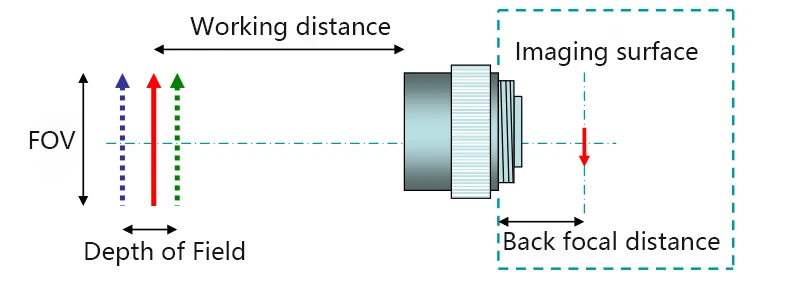
Focal length is one of the most critical lens parameters, typically measured in millimeters (mm). It determines the lens's imaging magnification and field of view. A shorter focal length results in a wider field of view, making it suitable for large-scale production monitoring. A longer focal length results in a smaller field of view, making it suitable for magnified inspection of product details. For example, a 25mm lens is suitable for medium-range inspections, while a 75mm lens is better suited for long-distance or detailed inspections.
Working Distance
The working distance is the distance from the front of the lens to the surface of the object being measured. A short working distance provides greater magnification but is less convenient for equipment installation. A long working distance facilitates wiring and assembly but reduces magnification. When selecting a sensor, consider the actual production space and inspection requirements.
Aperture Range
The F-number indicates the aperture size of the lens, which directly affects the amount of light entering and the depth of field. A small F-number (such as F2.8) has a large aperture, allowing more light to enter and producing a brighter image, but also has a shallower depth of field, making it suitable for low-light environments or applications that require highlighting a specific surface. A large F-number (such as F16) has a small aperture, allowing less light to enter, but has a deeper depth of field, making it more suitable for inspecting multi-layered or uneven objects.
Field of View (FOV)
The field of view (FOV) refers to the angular range of a lens's imaging range, directly determining the extent of the image a camera can capture. It is closely related to the focal length and sensor size. A larger FOV is suitable for global inspection, while a smaller FOV is more suitable for localized, detailed inspection.
Distortion
Distortion describes the geometric error between the image and the actual object shape during the imaging process. Common examples include barrel distortion and pincushion distortion. For high-precision measurement, distortion must be kept as low as possible (e.g., less than 1%); otherwise, measurement accuracy will be affected. For applications requiring only observation, this value can be relaxed.
Lens Mount
Common mounts for industrial lenses include C-mount, CS-mount, F-mount, and M42. The mount type must match the camera's; otherwise, installation may fail or image quality may be affected. C-mount is the most common standard and is compatible with most industrial cameras.
Sensor Size
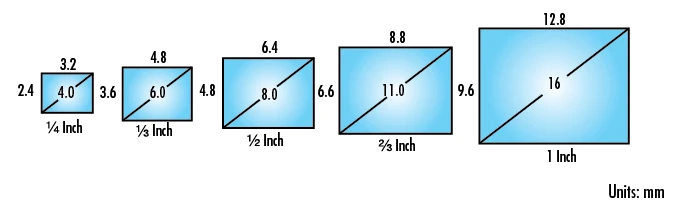
The lens must cover the camera's image area (e.g., 1/3", 1/2", 2/3", 1", 4/3", etc.). If the lens's image circle is smaller than the camera's sensor size, vignetting and image edge blurring will occur. If the lens's image circle is larger than the sensor, better edge image quality will be achieved.
Optical Length
The total optical length refers to the physical length of the lens and its optical path design, which affects the system's installation space. For compact devices, a short lens is preferred.
Magnification
Magnification refers to the ratio of the object's image size on the sensor to its actual size. For example, 0.5x means the object is imaged at half its actual size. High magnification is suitable for inspecting tiny structures, while low magnification is more suitable for inspecting large, integrated objects.
Depth of Field
Depth of field refers to the ability of an object to remain clearly visible within a certain range of depth. A larger depth of field allows for sharper images at different heights. A smaller depth of field results in a sharper image but requires more precise focus.
MTF (Modulation Transfer Function)
MTF is an important metric for measuring lens resolution and contrast. It reflects a lens's ability to reproduce detail at different spatial frequencies. Higher MTF values indicate sharper images, with better edge and detail rendering. It is a crucial performance parameter for high-end lenses.
Industrial lens selection isn't a single consideration; it requires a comprehensive consideration of optical specifications such as resolution, working distance, magnification, depth of field, and distortion, combined with camera specifications and application requirements. Proper lens selection not only improves image quality but also ensures the stability and accuracy of machine vision systems.
Zhixiang Shijue offers a comprehensive range of imaging lenses and other vision equipment, helping customers choose from a variety of options, including fixed-focus lenses, infrared lenses, telecentric lenses, and fixed-magnification lenses. Please Contact US to learn more about our products.


